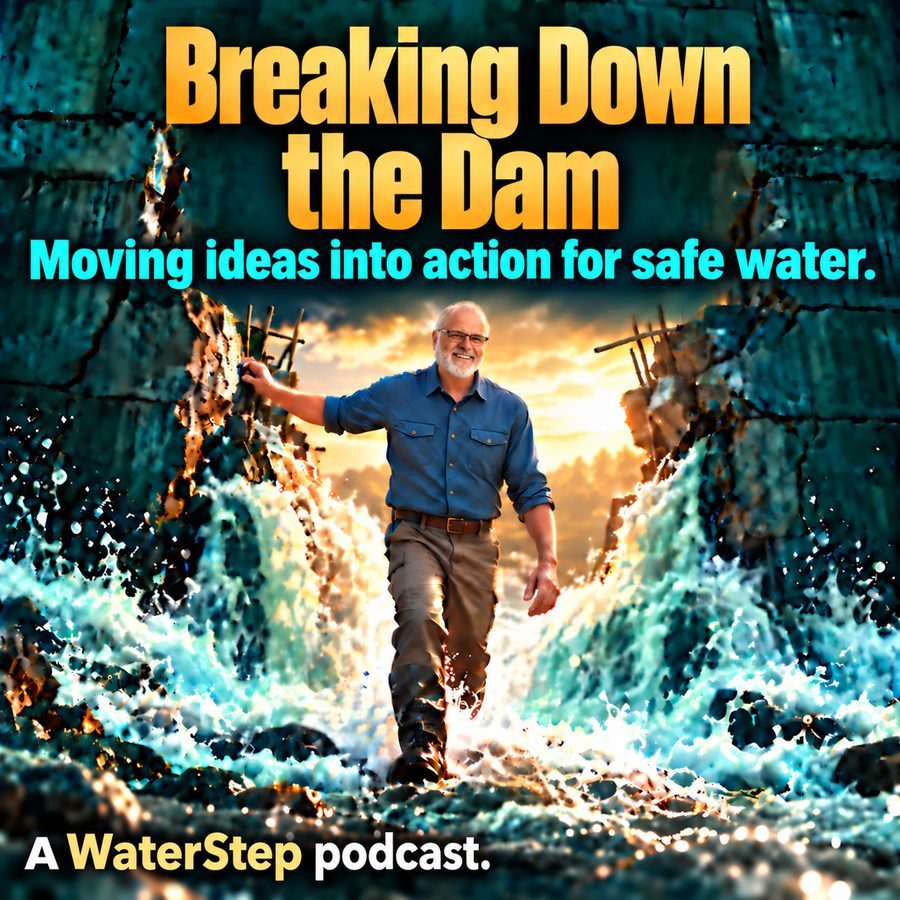
Mark Hogg walking out through a broken concrete dam as water rushes past him at sunrise.

Breaking Down the Dam

Moving ideas into action for safe water.

A one-on-one conversation with leaders who’ve seen what stands between people and safe water and refuse to accept it.

They’re the people closest to the problem. They’ve stood in the disaster zone, the regulator’s office and the village where the pump failed, and watched good work stall. Now they’re determined to break through.

One-on-one · About 30 minutes · On video, on WaterStep’s YouTube channel

Water galvanizes people.

Safe water is the one goal a regulator, a rural water operator, an emergency manager and a field worker on another continent all share. The technology to make water safe is mostly not the problem anymore. The problem is the barriers that keep it from reaching people.

Over thirty years of water work in dozens of countries with the people of WaterStep, in emergency response here at home, and in countless conversations at conferences, Rotary clubs and around kitchen tables, Mark Hogg has heard the same thing again and again: the barriers are real, and most people facing them feel like they’re pushing alone.

This podcast gives them a place to name the dam out loud and find out who else is pushing on the same wall.

Each conversation moves it.

We don’t break the dam in one episode. We move it, one encounter at a time.

  1. Name it

    Put words to the barrier you’ve been carrying.

  2. Go deeper

    Where does it break down? Who owns the decision? What do you need that you can’t get?

  3. Draw it out

    Mark listens and asks until what you already know gets said out loud.

  4. See it together

    Once it’s spoken, everyone can learn from it: you, Mark, and everyone else pushing on the same wall.

Dams can be broken.

Every “no” becomes a blueprint. Three walls that are already coming down:

Mobile water treatment

It had no certification, no state path and no place in disaster plans. Persistent conversations built all three. Today it’s certified to a recognized standard, written into Kentucky’s disaster response plans, and tested by the U.S. Army in the field and in the Arctic.

Jamaica, ready for the next storm

After Hurricane Melissa, Jamaica is taking anticipatory action: 320 BleachMakers are being placed in public hospitals and health centers in all 14 parishes. When the next storm hits, each can make its own disinfectant on site instead of waiting weeks for a shipment.

Liberia’s hand pumps

For the first time, communities in rural Liberia can diagnose their own hand pumps with a new app that also records each pump’s history. The pilot will assess more than 800 pumps, reaching tens of thousands of people. Better information means faster repairs, better water access, and hope.
Who you’ll hear from.

  • Regulators and standards bodies

    The people who decide how a new technology earns its place in codes, standards and law.

  • Emergency managers and public health

    Those who know what happens when a ready system meets a state with no path to use it.

  • Rural water leaders

    The operators and associations who stand between small towns and the statehouse.

  • Disaster response, at home and abroad

    From the Caribbean to West Africa, where water is often the first system to fail.

  • Indigenous and community voices

    People closest to the problem, telling it on their own terms.

  • Operators and trainers

    The ones who’ve hit the wall in the field and kept pushing.

Mark Hogg, founder and CEO of WaterStep.

Mark Hogg

“People often don’t take me seriously. I do the work anyway.”

In 1983, as a college student on a mission trip to Burkina Faso, Mark saw children drinking from a muddy lake and spent months helping build a dam. He couldn’t unsee it. He went on to found WaterStep in Louisville, Kentucky, where for more than thirty years they have built simple, field-tested safe water technology, trained local people to run it, and then gotten out of the way.

WaterStep’s equipment is built largely by volunteers and has reached people in 72 countries, from disaster zones at home to hospitals in India and communities in the Democratic Republic of Congo. In 2013, Mark was named the inaugural Muhammad Ali Kentucky Humanitarian of the Year for his work on the world’s water crisis.

Mark isn’t the expert in the room. He’s the one who gets the right people talking, and keeps asking until the answer is said out loud.

18M+
people served with safe water
72
countries reached
5,000+
projects deployed

Listen and watch.

The first conversations are being recorded now.

New episodes will be published on WaterStep’s YouTube channel, with short clips on LinkedIn. Subscribe to catch the first one when it goes live.

Breaking Down the Dam podcast cover art: Mark Hogg walking through a broken dam. Moving ideas into action for safe water. A WaterStep podcast.

Be a guest.

If you’ve stood where safe water gets stuck, as a leader, regulator, responder, operator or funder, Mark would like to hear your story.

  1. Tell Mark a little about the barrier you’ve been pushing on.
  2. Pick a time for a conversation of about 30 minutes, recorded online. No prep needed.
  3. Get the finished episode and short clips to share with your own network.

Rather send an email? Write to mark.hogg@waterstep.org.

Tell Mark your story

A few lines is plenty. Mark’s team will reach out to set up a time.